
Malaysia’s Private Health Care Sector Among Asean’s Strongest: Frost & Sullivan
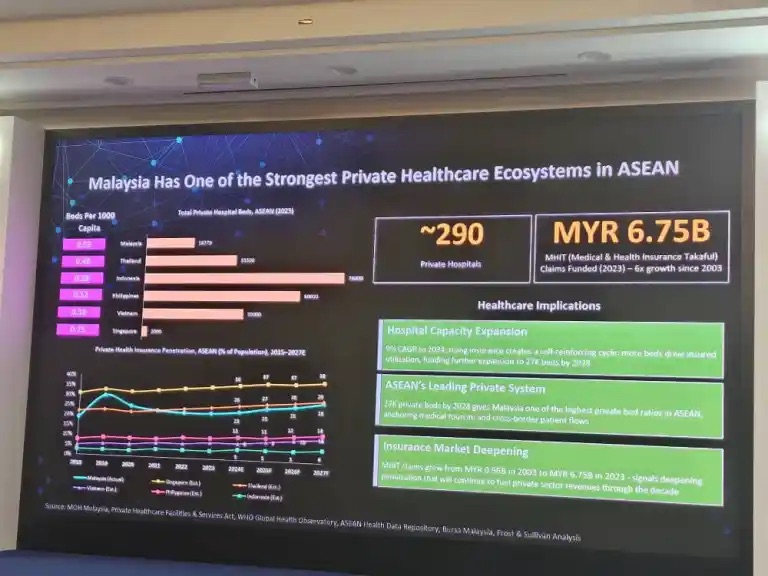
KUALA LUMPUR, July 14 — Malaysia has one of Asean’s strongest private health care ecosystems, supported by expanding hospital capacity, rising private health insurance penetration, and a well-established medical tourism industry.
Frost & Sullivan head of health care and life sciences (advisory, APAC) Rathanesh Ramasundram said Malaysia currently has about 290 private hospitals and nearly 19,000 private hospital beds, giving it the second-highest private hospital bed ratio among major Asean markets at 0.58 beds per 1,000 population, behind only Singapore at 0.75.
By comparison, the Philippines has 0.52 private hospital beds per 1,000 population, followed by Thailand (0.49), Vietnam (0.39), and Indonesia (0.28).
“Private sector expansion is one of the largest contributors to health care growth in Malaysia,” Rathanesh said at the 21st Bursa Malaysia-Hong Leong Investment Bank Stratum Focus Series here last July 2.
She added that hospital operators were increasingly expanding beyond tier-one and tier-two cities by opening new branches and acquiring hospitals in smaller markets or “tier-three cities”.
The trend mirrors recent private hospital expansion beyond major urban centres, including KPJ Healthcare Berhad’s new hospital in Kuala Selangor and Thomson Medical Group’s planned hospital in Iskandar Puteri, Johor. The Selangor government has also entered the private health care market with the opening of Selgate Rawang Hospital.
Frost & Sullivan, a business consulting firm, projects Malaysia to have about 27,000 private hospital beds by 2028, giving the country one of Asean’s highest private hospital bed ratios and reinforcing its position as a regional hub for medical tourism and cross-border patient flows.
Rathanesh said the sector’s continued expansion was also supported by rising private health insurance penetration and a growing middle-class and affluent population.
Malaysia ranks behind only Singapore and Thailand in private health insurance penetration among major Asean markets, while medical and health insurance/takaful (MHIT) claims funded increased six-fold from RM960 million in 2003 to RM6.75 billion in 2023, reflecting the steady expansion of private health insurance over the past two decades.
“The more middle-class and affluent populations grow, the more they can afford private health care services,” Rathanesh said.
Medical Tourism Underpins Private Health Care Growth
Rathanesh said medical tourism continued to be one of the biggest growth drivers for Malaysia’s private health care sector, with Malaysia now ranking second only to Thailand in the region for international patient arrivals, ahead of Singapore.
According to the Malaysia Healthcare Travel Council (MHTC), Malaysia recorded 1.8 million medical tourists and RM3.35 billion in health care travel revenue in 2025.
About 60 per cent of Malaysia’s medical tourists come from Indonesia, although hospitals are increasingly diversifying into other source markets as patients from different countries seek different specialist services.
Malaysia is home to eight of the world’s 30 Reproductive Technology Accreditation Committee (RTAC)-accredited fertility centres, with an IVF success rate of 82.9 per cent, compared with a global average of about 50 per cent.
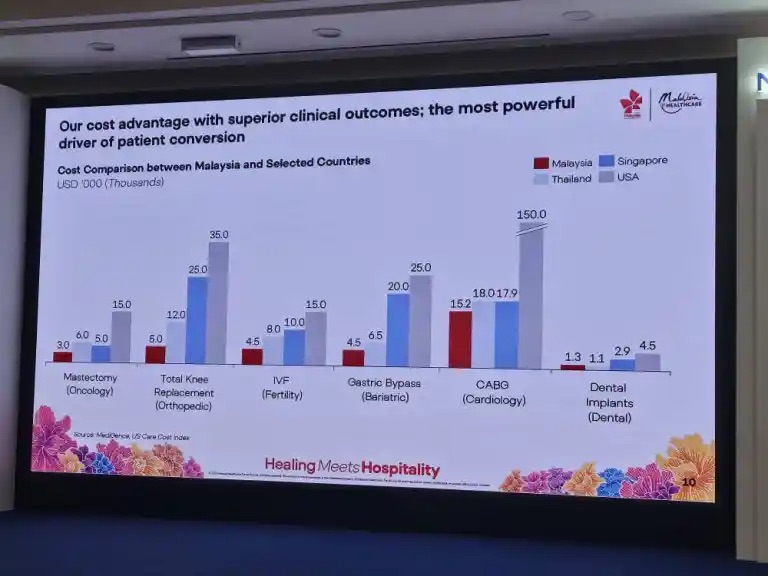
IVF treatment in Malaysia typically costs between US$4,000 and US$5,000 (RM16,320 to RM20,400), substantially lower than the US$12,000 to US$15,000 charged in the United States.
Malaysia has more than 30 cardiac centres, including the National Heart Institute (IJN), while its cancer care services have been strengthened through advanced imaging and cancer detection technologies.
Malaysia also ranks as the third most cancer-prepared health care system in the Asia-Pacific region, with demand for oncology services also growing among patients from China, Indonesia, and Myanmar.
“Thailand may be known for aesthetics, but Malaysia has built strong centres of excellence in cardiology, orthopaedics, IVF, and cancer care,” Rathanesh said. “Beyond these, hospitals are also expanding into other specialty areas because that’s where future opportunities lie.”
Workforce Shortages Constrain Expansion
Despite strong growth prospects, private hospitals say workforce shortages remain one of the industry’s biggest constraints.
Association of Private Hospitals of Malaysia (APHM) honorary secretary Anwar Anis said Malaysia’s specialist workforce appeared adequate on paper, but the headline figures did not reflect the number of senior specialists who were now semi-active or semi-retired.
“There is a significant number of specialists in private health care who are semi-active, or you can even say semi-retired. So the numbers don’t tell the whole story. There is a need for specialists,” Anwar said.
He estimated that between 20 and 30 per cent of specialists aged 60 and above were now semi-retired, reducing the effective specialist workforce in the private sector.
Anwar also argued that a strong private health care sector helped retain Malaysian specialists who might otherwise leave the country.
“We get accused often enough that private health care keeps taking specialists from the government,” he said. “The counter-narrative is that if there was no private health care, many of these doctors would leave Malaysia for Singapore or Australia.”
Anwar also pointed to persistent nursing shortages, saying some hospitals had been unable to fully utilise existing infrastructure because they lacked enough nurses to operate additional beds. “You can build hospitals, you can build beds, but if you don’t have the nurses, you cannot open those beds.”
APHM: Stronger Primary Care Needed To Curb Hospital Overutilisation
Anwar argued that Malaysia needed to strengthen primary care as the health system’s gatekeeper to reduce unnecessary hospital utilisation and address the underlying drivers of rising health care costs.
He said many conditions currently treated in private hospitals could instead be managed by general practitioners (GPs), but patients often bypass primary care because private insurance typically covers hospital treatment rather than GP consultations.
“We’ve been saying this for the last 18 months. The World Bank says the same thing. We need stronger primary care as the gatekeeper,” Anwar said.
He said APHM agreed with recommendations in the World Bank’s recent report commissioned by the government, which found that some of the most common conditions treated in private hospitals could have been managed at the primary care level.
“Care that does not need to come to secondary or tertiary hospitals is coming to hospitals. It can actually be tackled at the primary care level. So that is causing overutilisation at the hospital level, which is also driving up costs.”
Anwar argued that the government’s Reset reforms focus on containing hospital costs without sufficiently addressing the underlying causes of rising health care expenditure.
“We don’t see a strategy where we are involving primary care. It is absent. The interventions are an immediate reaction because premiums are going up, so we look at hospitals and try to control costs, but we’re not addressing the root cause.”
Anwar said strengthening private primary care would allow hospitals to focus on complex cases instead of routine conditions, reducing unnecessary demand for hospital beds while improving overall efficiency.
“We don’t have to build a lot more beds, we don’t have to struggle with staffing. We can provide high-value, high-complexity care, while the bread-and-butter cases are managed at the primary care level. That can bring down costs for the country.”